Sonifying Contact
Abstract
To better understand contact, we provide a setting which combines haptification and sonification in a way that integrates formal, discursive and embodied approaches. To analyse contact through touch, we augment the haptic-auditory continuum by a sonification of a specifically conceived physical model of friction. Operator based sonification allows us to focus on the formal relationships that govern contact dynamics. The stick-slip phenomenon thereby opens a surprisingly subtle case of the coupling between force-feedback and auditory display.
The paper provides a conceptual and mathematical analysis of the stick-slip phenomenon against the backdrop of this haptic and sonic experimental system. A formal treatment of contact is a starting point for a series of sonifications each of which foreground a different otherwise hidden or inaudible aspect of contact dynamics. We show that the model behaves as specified and that the procedure as a whole allows us to develop new ways to navigate and study the haptic-auditory continuum.
Recordings
These recordings were made at the Institute for Music and Media for the article Eguia, Manuel and Rohrhuber, Julian – “Sonifying contact: stick-slip dynamics and the fractured haptic-auditory continuum”, to be published in the proceedings of the 31st International Conference on Auditory Display (ICAD 2026). The work is done as part of the Haptic Thought Laboratory.
Each file name corresponds to one of the operator based sonifications (all with a time scaling factor $\mathring{t} = \delta_t t$) described in the paper. In the following, we provide some context using the relevant section numbering in the paper. The files are provided in compressed (mp3) format.
When listening to recordings, two important aspects are missing: the haptic sense of the forces, and the sense of variation that comes from interactive sonification. Nevertheless, the recordings may help to understand the method we have followed in the paper.
Parameters
muStatic: 0.4, muKinetic: 0.1, damping: 1, delta: 0.1
The horizontal stiffness is given here in two versions for comparison: 300 N/m and 3000 N/m, which for a displacement of 3mm correspond to a counter-force analogous to about 100g and 1kg.
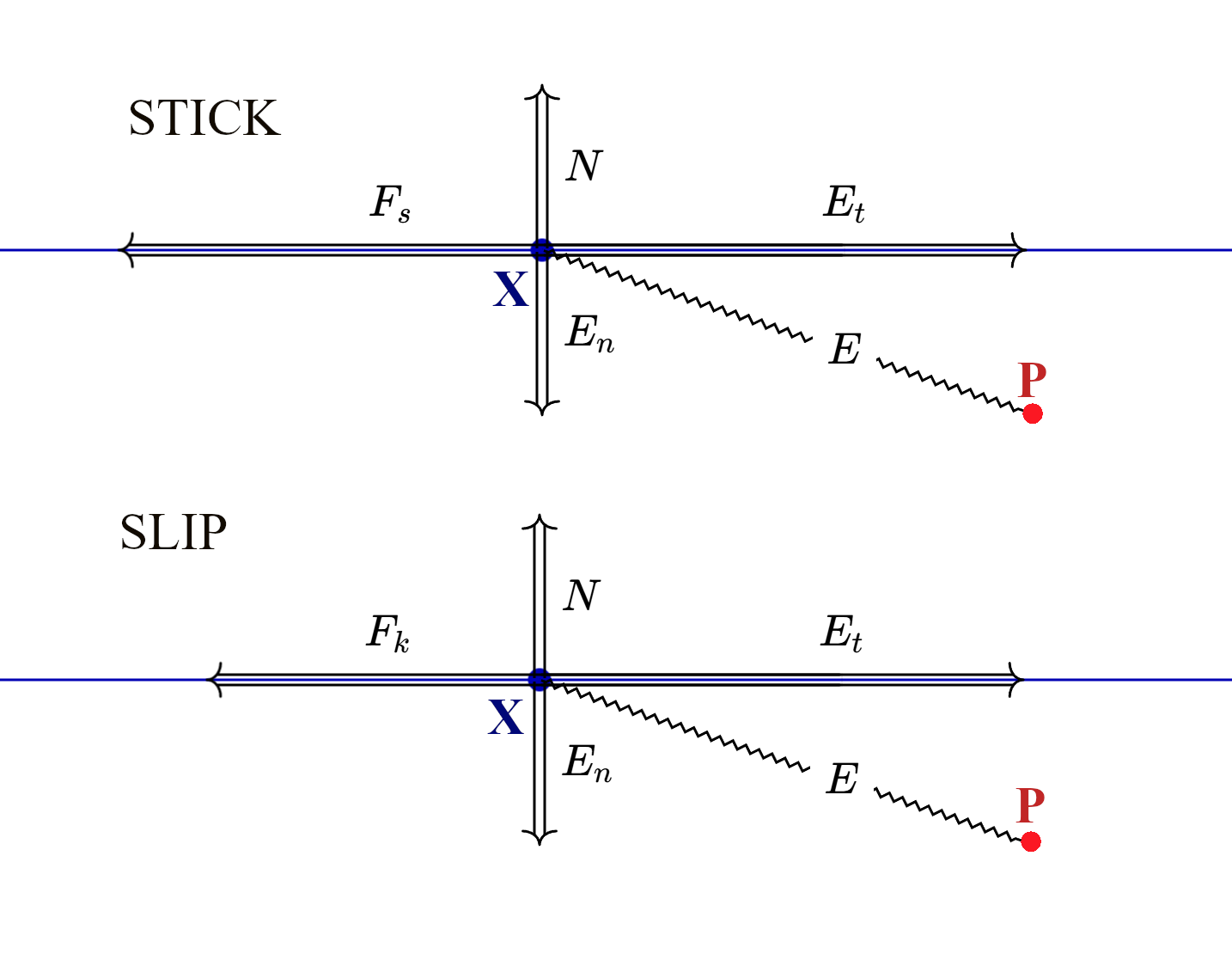
Stick–slip force balance (side view in the $y$–$z$ plane). The contact point $\mathbf{X}$ (blue dot) lies on the rigid plane (blue line) and is loaded by the handle position $\mathbf{P}$ (red dot) through an elastic force $\mathbf{E}$ with projections $E_n$ (normal) and $E_t$ (tangential). The plane provides the normal reaction $N$ in both regimes. Top (STICK): static friction $F_s$ balances $E_t$. Bottom (SLIP): tangential resistance drops to kinetic friction $F_k$, so $E_t>F_k$ and $\mathbf{X}$ relaxes tangentially until sticking becomes admissible again.
2.2.2. Sonification of forces
For the frequency, a (co- and contravariant) exponential mapping was used, and a covariant linear mapping for the amplitude, using the following ranges:
minFreq: 100, maxFreq: 3000,
maxForce: 5, maxAmp: 1
horizontal stiffness: 300 N/m
horizontal stiffness: 3000 N/m
2.2.3. Sonification of the limit: potential and kinetic energy
horizontal stiffness: 300 N/m
- stick-slip-icad-16-potential - f_0 = 290, muStatic: 0.4, muKinetic: 0.1, damping: 7, delta: 0.1
- stick-slip-icad-17-kinetic - f_0 = 290, muStatic: 0.4, muKinetic: 0.1, damping: 7, delta: 0.1
horizontal stiffness: 3000 N/m
- stick-slip-icad-16-potential - f_0 = 290, muStatic: 0.4, muKinetic: 0.1, damping: 7, delta: 0.1
- stick-slip-icad-17-kinetic - f_0 = 290, muStatic: 0.4, muKinetic: 0.1, damping: 7, delta: 0.1
2.2.4. Audification of stick-slip transitions: stick-slip-icad-19-onsets
horizontal stiffness: 300 N/m
- stick-slip-icad-19-onsets - muStatic: 0.4, muKinetic: 0.1, damping: 1, delta: 0.1
- stick-slip-icad-19-onsets-binaural - muStatic: 0.4, muKinetic: 0.1, damping: 1, delta: 0.1